Monday, March 20, 2006


IT WILL COME AS NO SUR-PRISE

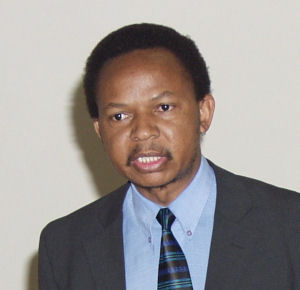
that Professor Geoffrey Kiangi has been 'rumbled' for an attempt to remove 12 computers from the premises of the University of Namibia. Indeed, the only surprise is that

i) the good professor has lasted so long

ii) that he has been caught in what for him must be such a 'small beer' transaction.

'Professor' Kiangi is by origin a Tanzanian national, who since he came to Namibia in the early 90's has enjoyed a mysterious level of influence and popularity with the Namibian government, and has posed as an official authority on all things IT. He had an engineering qualification from a provincial British university, was a lecturer in the old Windhoek Academy, then without any visible computer experience, was appointed head of Computer Science at the newly established University of Namibia. Then, without any apparent IT research activity, he was appointed a full Professor. Since then he was widely suspected of running external courses, consultancies and programmes, using University premises, facilities and equipment, and salting away the proceeds.

So that 12 computers was a very minor item to get involved in, especially with the equally non-qualified head of the Computer Centre. Why didn't he just hire someone to drive the getaway car? No doubt he will manage to convince the cops that the computers were for an urgent downtown 'community project'.

Anyway, what a fantastic example for the country's youth and students.

Wednesday, February 01, 2006


Has anyone noticed
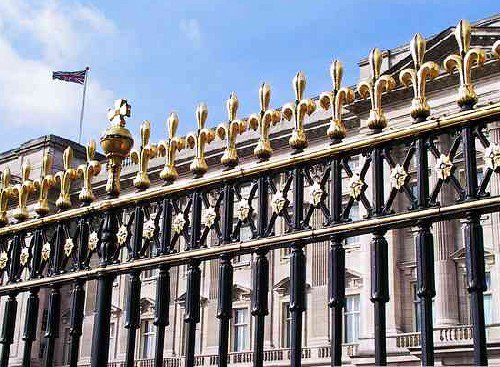
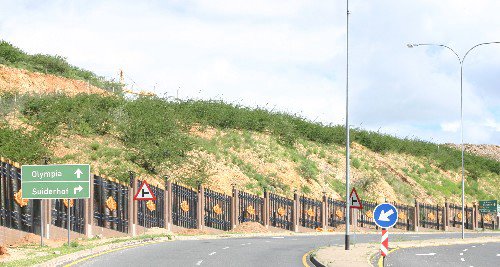
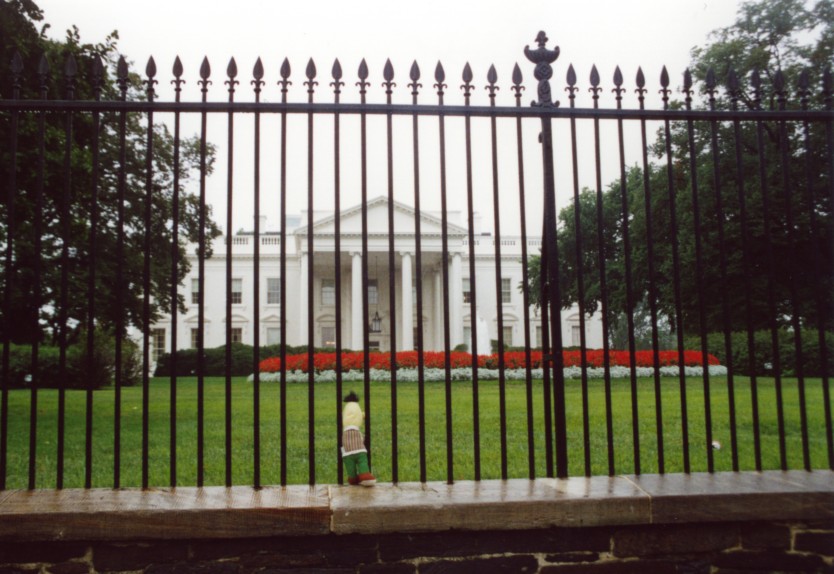
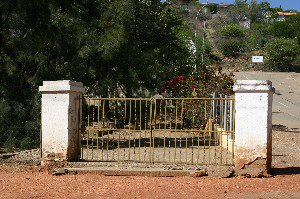
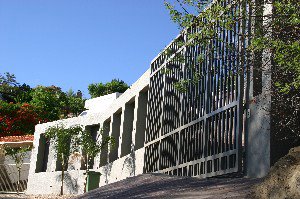
Our Founding Father's fabulous fence going up around the new State House? It is just as grand as the railings around Buckingham Palace, and much grander than the fence around the White House (see pictures). And what are the gold medallions/logos adorning each section? They seem to bear no resemblance to any Namibian state coat of arms. Maybe they are leftovers from some Nanjing trade fair? Actually the upper logo looks suspiciously like a crown - is a monarchy creeping in by the back door?
You can imagine what the fence must cost (per meter, and it stretches for a couple of kilometres) - what does that imply about the cost of the House?
Of course, this illustrates the law that the grandeur of the presidential palace plus motorcade of any country, and the prosperity of the average citizen of that country, are in inverse proportion to each other.
The golden barrier may be intended to keep the peasants a) out and b) in awe; but so were the walls of Jericho and the great gates of Babylon, and, if I remember the Bible correctly, they didn't work out.

Tuesday, January 10, 2006

A recent article abo

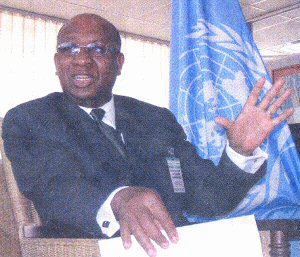
(picture coutesy The Namibian)
A recent article about the United Nations in Nam.

in the local press (Namibian, 22/12/05, not on-line), and its new resident representative. Included, the news that the UN are spending N$ 70 million (US$ 12 million) on a new UN headquarters in Windhoek. Quite apart from the fact that this ‘headquarters’ has damaged a thickly wooded and environmentally sensitive part of the Klein Windhoek river bed, can one ask why the UN is not spending this money in Dafur or somewhere? Namibia is a (reasonably) settled and grown-up country now, and we should be able to tackle our own problems without being nannied by the UN and its UNDAF (or UN-Daft) fund. The UN Resident Representative says that “by 2010, the UN hopes to have strengthened the country’s response to the HIV-AIDS pandemic”. Well, I doubt whether the endless generously funded conferences and 'workshops' will lessen the AIDS pandemic by one single case. Hot air has not yet been medically proven to be a cure for Aids, nor unfortunately, just on its own, is money. And education programmes? If anyone does not know yet the causes of HIV infection, I don’t think further education is going to help much. Rephrasing, I think the N$70m would have been better spent on ARV's than on a new paper-shuffling palace for the UN from which it can launch more 'education' programmes.
The new UN representative, Mr. Nhongo, says that Namibia is the country with one of the biggest income disparities in the world (right) and that “turning this situation around is a major challenge for the UN” (wrong). I did not know that social and economic re-engineering within a country is a job for the UN – don’t they have anything else to do?
In previous years, the UN has rented offices in Windhoek. Now, according to the Representative, "the money saved on rent (in his new N$70M building) can be put towards development assistance”. Assuming that the rent paid by the UN could not be more than say N$ 50 000 per month, and the finance payments on a ‘home loan’ of N$ 70m, assuming you could get such a thing, would be about N$ 700 000 per month, (even though the government i.e. the namibian taxpayer has chipped in a bit) it makes one tend to agree with those who are sceptical about the UN’s ability to plan its finances.

Sunday, January 01, 2006


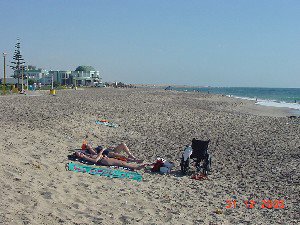
Views from the beach

at Swakopmund, and the last African sunset of 2005 from the Namibian coast at 8 pm yeserday. Have a good one.

Thursday, December 29, 2005


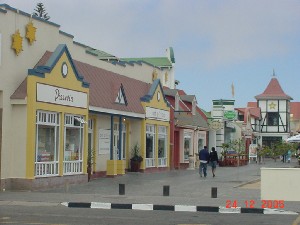
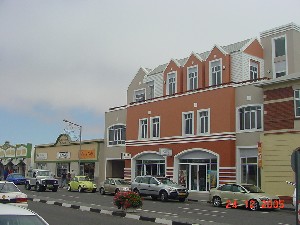
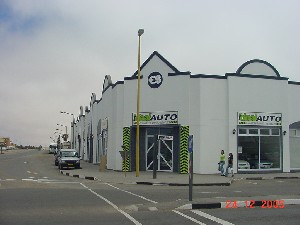
Boxes, little boxes, they used to sing years ago.

I'm referring to the rapidly changing appearance of Swakopmund. A local paper said that many of the town's best-known buildings were disappearing, to be replaced by structures aka instamatic holiday flats with all the aesthetic appeal of lego blocks. I disagree - a libellous statement about Lego, whose blocks do have much appeal. Have a look at the above examples - the black and white stage-set frontage - what is it supposed to be? Apart from the €$ symbol - the sole deoration on the edifice - it looks pretty cheap. Also the twee cardboard gables and the intent to create a fake kaiser-kolonial theme park. Which are the real buildings and which the fakes? Clue - most of them are fakes. Anyway, a happy new year to all. The season for jollity and not for whingeing. Just bring your headache tabs if you are visiting here.

Sunday, December 18, 2005

DID YOU SEE

the hilarious ads in the namibian papers the other day placed, by the state Telecom monopoly, using our money, and issuing dire warning about the prevalence of "illegal" practices?

You can get the full text of the advertisement here.

These dangerous, subversive, illegal practices (remember this is the 21st century) include VOIP, Wireless Internet Access (shocking) and International callback services. All systems, in fact, which enable ordinary people to conduct their communications in an affordable manner and bypass ramshackle state services and their diktat charges. Can we detect the cries of said state organisations desperate to prop up their pathetic monopoly before it gets kicked from under them? Maybe our dear Telecom is looking over its shoulder to South Africa, where the state telephone monopoly, which has been ripping off its hapless customers for half a century, is about to get a vastly overdue free market competitor.
Anyway, the ad reveals solomnly that Telecom "regularly receives complaints about outright violations of telecommunication legislation". Right - many people are 'outraged' that private systems offer them overseas calls for 40c per minute for instance when they could be paying N$6 per minute to those nice Telecom people. Not to mention 30c per minute for dial-up Internet services.
And how is Telecom going to enforce the 'law' - for instance to stop a Namibian using VOIP on a German hosted website? And how is Telecom Namibia going to prosecute a US based call-back service and put it out of business?

The main thing about the Interent is the transcending of political and legal jurisdictional boundaries. I can lend the worthies of Telecom some books about this if they are interested.

I recommend to Telecom that they stop wasting money on full page ads (and also incidentally stop sponsoring crappy events like boxing matches). Not to mention the millions spent on repainting everything with a stupid orange spotted logo which isn't original anyway). Use the savings to bring their PRICES DOWN. Maybe this would put them in a better position to be competitive to rival services when these inevitably come.

As for the Namibian Communications Commission (NCC) sitting in their air-conned offices 'regulating' on geovernment salaries (what do they actually do all day?) - the sooner they come out and seek honest employment the better. When 'regulation' is gone you will see the price of calls dropping form 40c to 4c per minute. But not before.

It's always sad in a way to see vested interests trying to hold back not only the march of technology but the people's access to it. Like the English Luddites who went around smashing those new-fangled steam engines - they were going to make transport affordable to the masses. Infringe the stage-coach monopoly? Can't have that!
The same applies (of course) to modern communications, and if Namibia Telecom and the NCC don't like it, they can stick it up their telephone jack.


Saturday, December 10, 2005


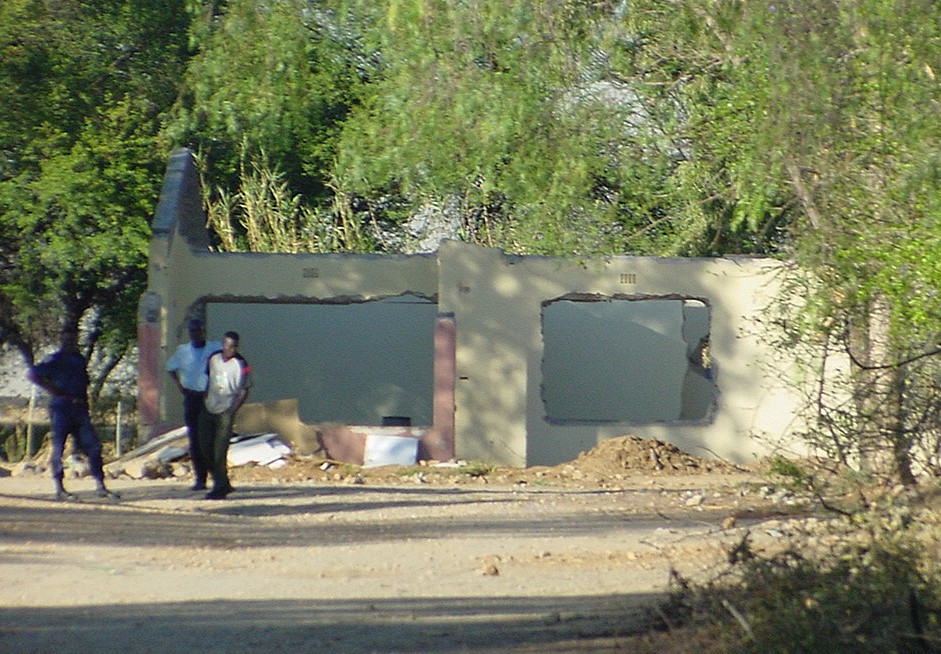
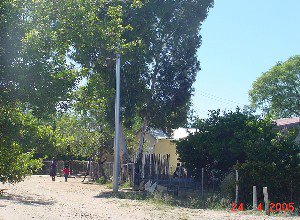
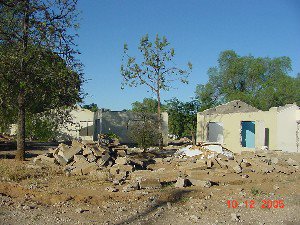
There used to be a mini-suburb of Windhoek, intriguingly surrounded by the Southern Industrial area, which resembled a rural Namibian town, with simple but perfectly sound houses, and gravel roads, shaded by huge gum trees, inhabited by local people - just a couple of streets off the main thoroughfare of Lazarett St. It was like an intriguing time warp. In April I passed by to take a few pictures (see above). Now, just a couple of weeks before the 'festive' seaon, I passed by again And was greeted by a forlorn sight - the houses had all been demolished, or left as empty shells, the people of course evicted and gone.
This land is owned by the Municipality who gave the excuse that the houses on it were 'substandard', not worth maintaining, and were going to be sold for 'resticted' business purposes. Let me guess - the sale will be 'restricted' to Mr. H. Pupkewitz, whose enterprises occupy the surrounding area. Mr Pupkewitz recently celebrated his 90th birthday, which simply means that he has been robbing Namibians for the past 60 years now. His latest exploit, achieved with a few well-placed bribes, was to induce the Goverment to forbid the direct import of good affordable used Japanese vehicles, so that consumers will continue to have to pay the inflated prices in his 'official' Nissan and Toyota dealerships.
So the little suburb by this time next year (the houses and trees all gone) will become the latest Toyota showroom, to match his new Nissan one next door. Something we desperately need.
Anyway, a merry sun-drenched Christmas to all our readers.

Saturday, November 12, 2005

pre-1990
2000
2005

Windhoek:

Suburban peripheral protection paranoia


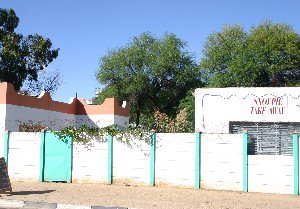
Above you see pictures of three garden gates/fences of various eras. The first is the the old fashioned scrolly wrought iron gate I remember when I was little. Easy for burglars to leap over but maybe there weren't so many then. Let's say that prior to independence in 1990 all gates and fences were like this, about 1 metre high. Next you see a typical garden wall, in the standard tasteful vibracrete surmounted by Dachau type razor wire, circa year 2000 and two metres high. Next you see the gate and wall of a newly erected house, i.e. 2005, some 3 and a bit metres high.


I am interested in the trend here - that is, the rate of average suburban wall height growth in Windhoek against time. The level of suburban paranoia I thought would increase exponentially; however, this is weighed back somewhat by the increased cost of building higher structures. Let is then guess that the rate of increase is quadratic, commencing at the 'origin' of year 1990. We then try to fit a parabola through points (x=1990, y=1; x=2000 y=2) where y is your average peripheral wall height.

This gives a relation like y = 0.01x^2 + 1, which when we substitute our year of 2005, gives y = 3.25 metres, a good approximation to the height of the 2005 wall. Extending this, we see the in the epochal year 2030 the height of the average garden wall and gate in Windhoek will be 17 metres, and in the year 2200 it will have attained 442 metres, higher than the plateau of the Gamsberg rises above the surrounding plain.

Have a safe weekend

bill torbitt

Tuesday, November 08, 2005


and more ugli fica tions
.....


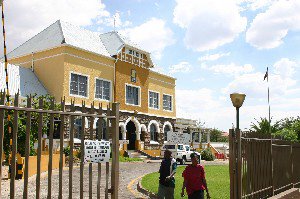
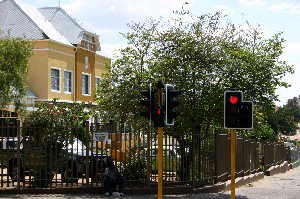
.....another newly erected eyesore in the middle of Windhoek is the addition to the College of the Arts, a rather beautiful 'colonial' building even with an ugly '70's extension next door. It had a nice little garden with rockery and lawn sloping down to the road (Fidel Castro St.), where students used to sit after lessons - now an spiky metal fence surrounds the whole (see pictures). Such a fine sludge colour too. A notice on the fence proclaims it to be the work of HJ Schulze so if you want an ugly fence of your very own you know where to go. Maybe there were security concerns at the college; but the only disaster I know of was when a member of staff, either playing computer games or trying to destroy financial records after hours, set fire to the main reception office. Spend the money rather on a new piano, or other instruments? You must be joking.
All part of the Namibian suburban periphery protection paranoia, of which more next time.

bill torbitt

Thursday, November 03, 2005


More ugli fica tions of Windhoek

The Ohlthaver and List group, Namibia's only conglomerate, which used to be a patron of opera and stuff like that (the music silly, not the browser) but since the death of its founder now firmly in the hands of the bean-counters, has given the city centre one of its most "attractive" features - a project which started in a orgy of constructional activity, and which most people assumed was going to emerge into a new shopping centre, turned out to be a car park - presumably finished but we don't know what the red spikes are for on top. Behind this stunning erection is another O&L effort - an ersatz German office block (yellow in background), its name as imaginative as the architecture ("Town Square") and just as unsuccessful commercially.
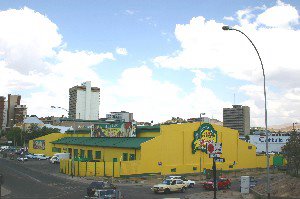
The other prime block of Windhoek CBD is occupied by a fruit and veg emporium (converted from a beerhall), appropriately in lemon yellow, and a cash building materials warehouse. The margins on potatoes and plasterboard must be higher than anyone realised.
More uglies tomorrow, and as always your suggestions welcome.

bill

Tuesday, October 18, 2005


The
ugly- fica tion
of Windhoek

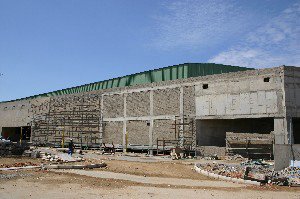
When driving through Windhoek lately I adopt a practice which is no doubt dangerous and contrary to traffic regulations - I try to keep my eyes closed. This because at every turn, some inoffensive older building has vanished to be replaced by some badly designed eyesore. You could drive up Jan Jonker, and enjoy the blue and emerald relief of the municipal pool by the small and thankfully not too successful Maerua park shopping centre, and have a burger at Saddles, overlooking the lawns and tennis courts - now all of that is swept away, to be replaced by a vast concrete block which looks not so much like a mega-mall before completion but Chernobyl after 'completion'.
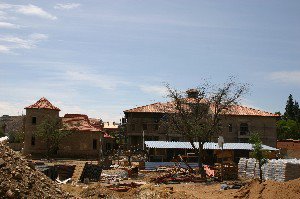
And what about the weird erection rising in Klein Windhoek? I hope the 'designers' will hold a competition in which you have to guess the architectural style which is intended to be captured - my guess is mainly Greek orthodox, with a touch of Japanese pagoda and flavoured with Amsterdam townhouse. But it is difficult to be sure.
The problem is that, unlike other professions, Namibia is a country where you can be throwing coconuts out of a tree one week, and be a practicing architect the next.

More eyesores tomorrow folks. Your contributions welcome.